Back on the Farm Again Lyrics
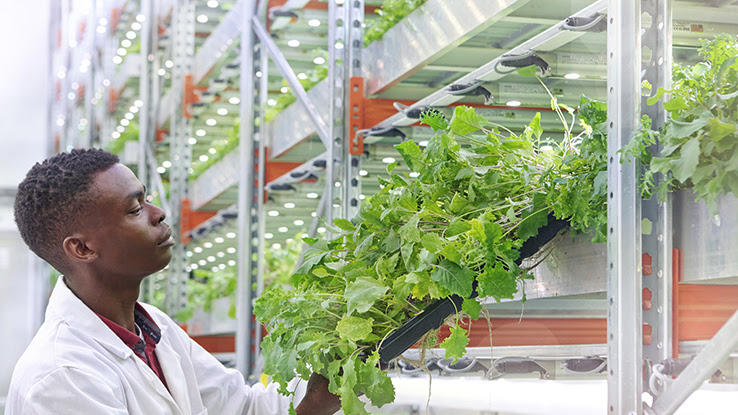
As the global population inches closer and closer to the eight-billion-people mark, the amount of sustenance needed to keep everyone fed continues increasing — placing stress on every attribute of our food system in the procedure. Farming of fresh produce in detail faces difficulties in scaling up production to meet our growing demand, largely due to the demand for more than space in which to grow crops. The primary manner farmers have responded has been to gradually prefer more efficient equipment for planting and harvesting crops, simply the way nosotros farm the land itself has largely remained unchanged. However, a new type of farming is currently knocking on the befouled door: Vertical farming is communicable the optics of farmers and investors alike.
With its less expensive and more sustainable methods, vertical farming may soon see more widespread utilization thanks to some of its key benefits. Not simply tin vertical farming reduce costs associated with product (and pass those savings forth to consumers), only drought-afflicted regions across the globe may also be meliorate able to grow only equally much produce with a fraction of the h2o traditional crops require.
Curious to find out how this concept could modify commerce, our climate — and the investing world? Join u.s.a. for a wait into vertical farming and the ways information technology may be an investment worth seeding.
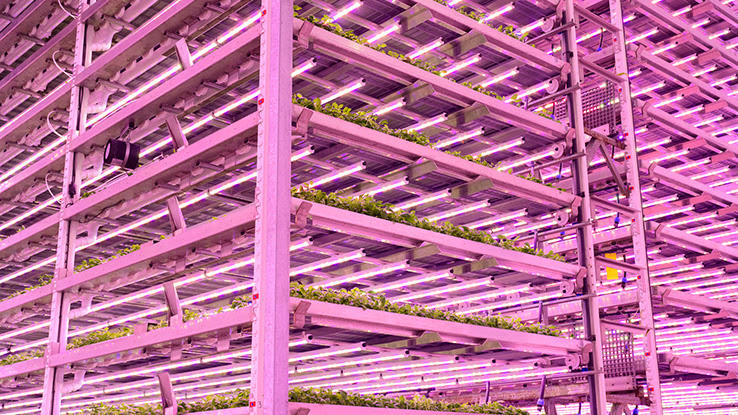
Vertical farming is exactly what it sounds like — plus a whole lot more. Farmers establish crops on surfaces that are stacked vertically, rather than spreading farther and farther out via the horizontal horticulture we've been used to for centuries. Because farmers tin can extend vertical layers up into the air, they can utilize more of their farmland for more vertical layers — and grow more on a much smaller footprint of ground. Vertical farming allows growers to found far more crops on the acreage they already own because they tin can aggrandize upward and no longer need to aggrandize outward.
It'south a like principle to apartment complexes. By edifice up, a much larger population tin alive on the same plot of state that might otherwise fit but a few families in sprawling houses. And, buildings and apartment complexes in metropolitan areas tin even use vertical farming to grow produce, allowing people to shop locally and subtract their carbon footprint.
Some vertical farms are built outdoors where crops are traditionally grown. Other farmers construct buildings, like warehouses and greenhouses, or utilize shipping containers to house the crops. Using these structures and advisable lighting equipment, farmers have the ability to grow crops year-round while limiting pest intrusion and damage from poor environmental conditions or natural disasters. Vertical farming can also allow growers to operate in areas that traditionally don't make platonic farmland.
Vertical Farming and the Climate
Equally mentioned, vertical farming holds the potential to combat climate change. When formerly farmed state is allowed to return to its natural country — a process called rewilding — that land's typical ecosystems, including native plantlife, can regrow and ameliorate regulate the surround.
Additionally, traditional farming strains water resources and is responsible for emitting almost a quarter of the world's greenhouse gases. But vertical farming uses between 70% and 95% less water than traditional agriculture uses for cultivation. Vertical farmers utilize hydroponic systems to h2o their crops, and these designs use much less water considering they recirculate information technology. The hydroponic systems create their ain unique ecosystem that recycles the h2o supply and opens farmers' options to growing practically any ingather whatsoever time of the year thanks to the abiding h2o supply. According to Harvard Business concern Schoolhouse, vertical farming's "technology tin yield as much every bit 350 times more produce in a given surface area equally conventional farms, with 1% of the water."
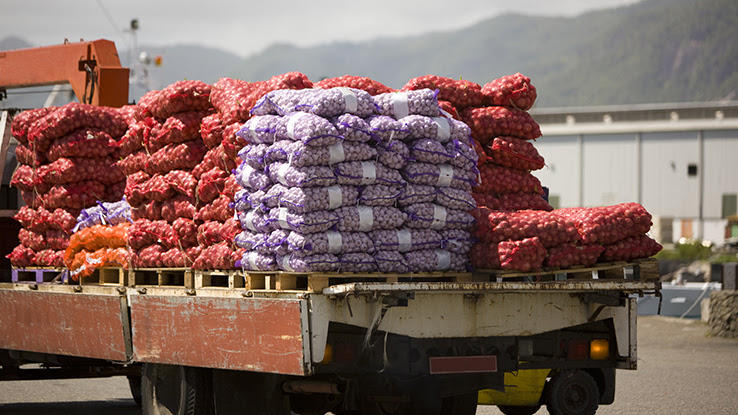
Vertical farming can limit agronomical contributions to climatic change in other means, too. According to the Centre for Biological Variety, "The U.South. transportation sector is responsible for about a 3rd of our state's climate-dissentious emissions." Function of that transportation involves shipping fresh produce from farms to cities, oftentimes from 1 side of the country to the other. Additionally, the United nations reports that, past 2050, 68% of the world's population is expected to live in urban areas, meaning more people living farther away from traditional farms — and more greenhouse gas-emitting freight trucks on the road to go fresh produce to grocery stores.
Vertical farms could present still another solution by limiting the need for cantankerous-country transportation in the food supply chain. Growers can construct these farms in urban areas or convert existing buildings into farming facilities, which provides residents easy access to food and helps them limit their own carbon footprints.
Should You Invest in Vertical Farming?

All investments come with varying levels of take chances, and emerging technologies like vertical farming tend to exist riskier considering their impacts and longevity aren't yet clear. However, vertical farming technology has already garnered the attention of private uppercase investors similar Google Ventures, which invested $xc million in the vertical subcontract-tech visitor Bowery Farming; IKEA, which has committed to investing $115 one thousand thousand in the indoor agriculture startup AeroFarms; and Softbank, which invested $200 million in Plenty, a vertical farming company that also utilizes bogus intelligence to manage crop growth.
This confidence is reassuring — and the potential for vertical farming indeed seems bright thanks to the positive way it stands to boost our access to nutrient while combating climate change at the aforementioned time. According to Forbes, "The indoor farming applied science market place was valued at $23.75 billion in 2016, and is projected to accomplish $40.25 billion by 2022," meaning it could nearly double, and soon.
However, while venture capitalists' decisions can serve every bit good endorsements, the boilerplate investor should take them with a grain of salt. This industry hasn't had much time to stabilize nonetheless, and it'due south vital to consider your level of fiscal risk tolerance earlier making the jump into investing. Additionally, many vertical farming companies haven't gone public even so, pregnant y'all can't invest in them for now — simply you can first researching to make a well-informed conclusion when the time comes.
Vertical Farming Stocks to Opt For
If you lot've decided to brand the investing leap and make vertical farming companies a part of your portfolio, you might be thinking of opting for commutation-traded funds (ETFs) instead of individual stocks for the time being. Considering ETFs can contain multiple types of assets and more evenly distribute risk among the assets they contain, they can exist platonic for newer investors who want to go a slice of this emerging industry. Instead of betting on a unmarried company'due south stock to perform well, an ETF allows you to hold multiple stocks from the aforementioned industry — and if one performs poorly, you won't have every bit much of a hit thank you to the congenital-in diversification.
Unfortunately, the vertical farming industry isn't quite at that place yet — in that location aren't any dedicated ETFs to provide you an like shooting fish in a barrel and diversified way in. Investing in vertical farming currently means investing in individual companies or in other agribusiness sectors that stand up to do good if vertical farming really takes off. That said, in that location are a few individual stocks you might consider adding to your portfolio. These include:
- AppHarvest (APPH), an indoor farming tech company that owns several of the largest indoor farms in the United States
- Jump Valley Acquisition (SV), a firm that's undergoing a merger with AeroFarms (one of the first vertical farming companies) and will soon exist available for public trading under the ticker ARFM
- Hydrofarm Holdings Group (HYFM), which manufactures the controlled indoor agriculture equipment used in vertical farming
- Hamlet Farms International (VFF), a company that creates and operates "mega-scale greenhouses" and likewise owns a cannabis-growing company, Pure Sunfarms
Vertical farming may indeed be the investment of the future — and you lot might likewise want to wait for the futurity earlier buying in. This emerging manufacture holds ample potential for growth, merely information technology's understandable if you determine to wait for ETFs to sprout up to mitigate your personal financial risk.

Source: https://www.askmoney.com/investing/is-vertical-farming-the-investment-of-the-future?utm_content=params%3Ao%3D1465803%26ad%3DdirN%26qo%3DserpIndex

Post a Comment for "Back on the Farm Again Lyrics"